patients deserve to have their wishes documented.providers deserve the tools to fulfill them.
advance care planning ordered from the chart, completed by patients on their own time with plain-language guidance at every step, and back in the record when it matters, so care matches wishes and hospitals avoid costly, unwanted treatment.

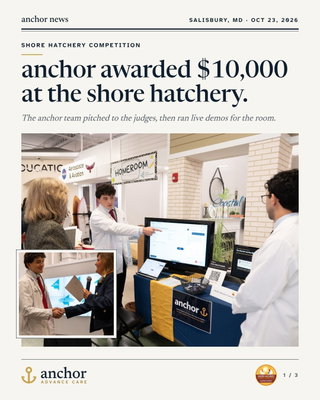
Winner of a $10,000 grant, Shore Hatchery 2026







the problem
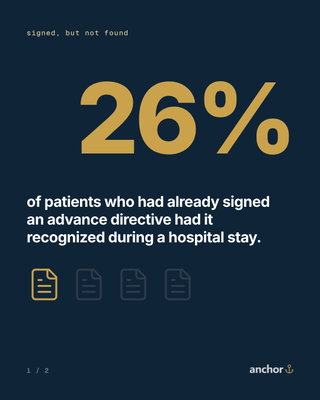
It fails three ways. Most advance directives are never made. When one does exist, nothing in the chart surfaces it at the moment a clinician needs it. And the documents that are on file are often outdated, duplicated, or contradictory.
All three land in the same place. When a patient's wishes are undocumented, unseen, or unclear, surrogate decision-making increases, unwanted interventions occur, ICU family burden rises, and quality measure performance suffers.
First, most are never made
54%
of Americans 65 and older have no advance directive on fileYadav et al., Health Affairs 2017
Americans 65 and older, per 100
Second, when one exists, nothing surfaces it
Only 31% of emergency physicians were confident they could locate ACP documentation, yet 74% needed it weekly (Lakin et al., J Palliat Med 2016)
55% of documented ACP discussions were not easily accessible in the EHR at the point of care (Walker et al., J Pain Symptom Manage 2018)
Third, what is on file often conflicts
21
MOLST forms on file for a single nursing home patient
anchor customer discovery, 2026
2 contradictory MOLSTs signed weeks apart, seen by one ethics committee chair (anchor customer discovery, 2026)
Why it matters to patients and families
63% of U.S. adults have no advance directive on file (Yadav et al., Health Affairs 2017)
86% vs 30% of patients who died had their end-of-life wishes known and followed with facilitated advance care planning, versus usual care. Their families had less stress, anxiety, and depression. (Detering et al., BMJ 2010)
Adults with an advance directive
63% have none on file. Yadav et al., Health Affairs 2017
Our goal with anchor: about 80% of referred patients.
how it works
Advance care planning starts with the physician, not with a form the patient has to find on their own. The visit becomes a review instead of the whole conversation.
ordered
A physician starts advance care planning for the patient.
completed
The patient finishes it on their own time, in their own words.
signed
It is signed and on file, ready when a clinician needs it.
what the chart ends up with
- a named health care decision maker
- the patient's wishes, in their own words
- a current MOLST, where it applies
why it matters
The same fifteen minutes, spent at two different points in time: long before a crisis, or in the middle of one.
With anchor, a short referral-to-completion window leaves the directive on file and retrievable. Without it, the same moment is lost to delay, confusion, and a rushed crisis response.
what we heard
from clinicians, ethicists, and health law experts we've spoken with.
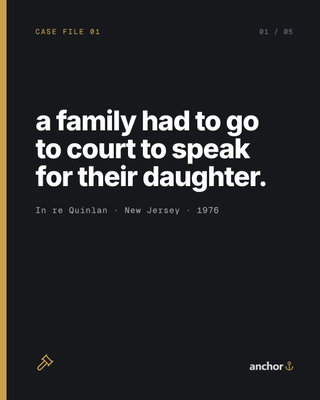
“If the patient has already decided and you're just carrying out their will, it's not the daughter's decision.”
“The number of times anyone has said, yes, I have that, is probably 5%.”
“There's like many places in [the EHR] where these advance directives live and they're not always named the same thing.”
“The provider can't rely on something that they can't see.”
“If you are looking for who is the surrogate decision maker, good luck with that.”
“I can envision a self-directed session a patient could complete on an iPad while waiting for their visit.”
who it serves
Health systems, long-term care facilities, and federally qualified health centers. Each has a reason to pay.
Health systems
every referred patient leaves with someone named to speak for them.
Advance care planning is hard to finish inside a visit, and directives are hard to find afterward.
Quality metric. Advance care planning completion is a provider-driven measure health systems already report on.
Long-term care
one current record, not a new form at every transfer.
Residents accumulate stacks of MOLST forms, and nobody can tell which one is current.
F-tag F578. CMS surveyors already enforce advance directive requirements. A citation lands on the facility's public Care Compare record.
Federally qualified health centers
advance care planning built for the patients you serve.
The patients least likely to have a directive are the patients health centers exist to serve.
CPT 99497 / 99498. Advance care planning is a billable service under the 2026 Medicare Physician Fee Schedule, though FQHCs are paid under a bundled system.
- Winner of a $10,000 grantRatcliffe Foundation Shore Hatchery competition, October 2026
- Runner-upCelebration of MD Student Startups, Johns Hopkins Pava Center, October 2026
- SemifinalistTEDCO and Lightwork University Pitch Competition, September 2026
- $2,000 awardGrid Pitch, The Grid at UMB, March 2026
- NSF I-Corps (Mid-Atlantic Hub)Extensive customer discovery across Maryland and beyond, spanning medicine, nursing, social work, ethics, and health law
- Patent pending
Investors: stage, status, and use of funds are on our investors page.
the team
Leadership
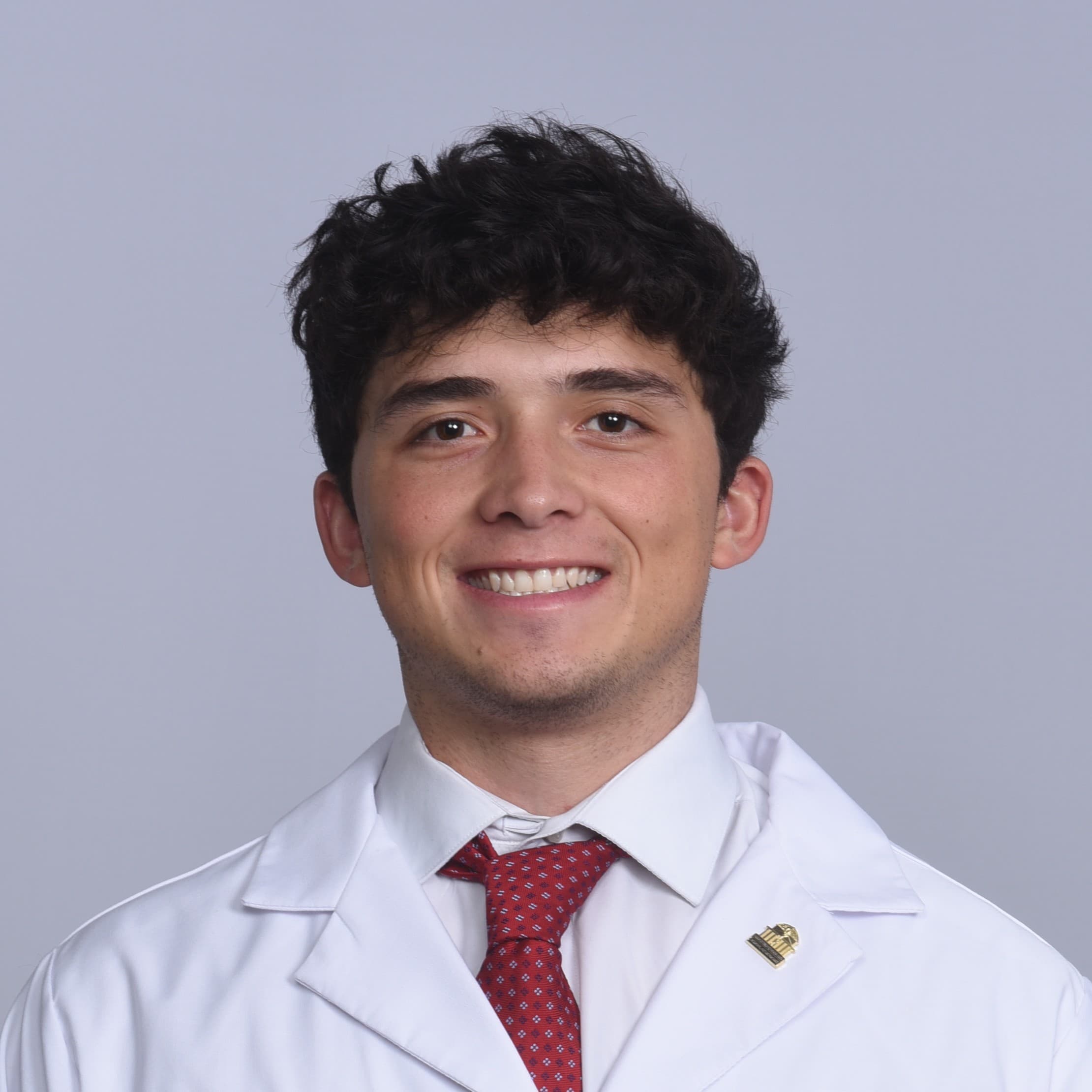
Julian Bolanos, B.S.
Founder and CEO
MD/MBA Candidate, University of Maryland School of Medicine and Robert H. Smith School of Business

Dariush Aligholizadeh
Head of Clinical and Research Strategy
MD/PhD Candidate (MSTP), University of Maryland School of Medicine
Advisory board

Diane Hoffmann, JD, MS
Legal Advisor, Health Law
Jacob A. France Professor of Health Care Law, University of Maryland Francis King Carey School of Law

Carolina Mendoza, MD, MBA, FAAEM
Clinical Advisor, Emergency Medicine
Assistant Professor, Department of Emergency Medicine, University of Maryland School of Medicine; Assistant Medical Director, Department of Emergency Medicine, University of Maryland Midtown Campus
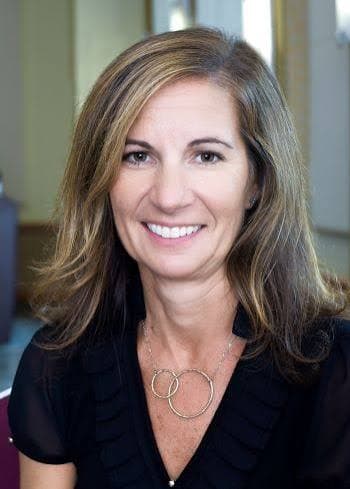
Joan Carpenter, PhD, CRNP, ACHPN, FGSA, FPCN, FAAN
Clinical Advisor, Nursing Home and Post-Acute Care
Associate Professor, University of Maryland School of Nursing; Health Scientist, Corporal Michael J. Crescenz VA Medical Center

Sumedh Shah, MD
Clinical Advisor, Neurological Surgery
University of Miami Miller School of Medicine; Jackson Health System
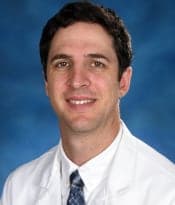
Daniel B. Gingold, MD, MPH
Clinical Advisor, Social Emergency Medicine, Population Health, and Primary Care Referral Coordination
Associate Professor of Emergency Medicine, University of Maryland School of Medicine; Deputy Medical Director for Population Health, Baltimore City Fire Department
Programs: NSF I-Corps, Mid-Atlantic Hub, TEDCO BRIDGE program.
trust and privacy
- Built on SMART on FHIR to work inside existing EHR infrastructure.
- Patient data is never sold.
- An independent security review and penetration testing will be completed before any pilot goes live.
request a pilot
The crisis is the wrong time to find out what a patient wanted. Tell us about your organization and we will reply within two business days. We read every message.
Or email us directly
contact@anchoradvance.care